Concrete Compass: Water
Water is essential to life and a critical resource, supporting business, environment and society. In the UK we enjoy clean water at the turn of the tap and think of ourselves as a water-rich country. However, water is a finite resource. Climate change is already having significant impacts on water availability and population growth will place increased demand on water supplies. Both of these factors have serious implications for the long-term management of water availability.
Water is used at many stages in the production process of concrete and its constituent materials. Concrete is also essential for the effective provision of safe and efficient water management in the built environment from the construction of reservoirs and dams, water supply and drainage systems, SuDs and provision of flood resilience.
This compass directs you to resources related to industry activity to improve the monitoring and management of water use in its supply chain, and manufacture, as well as guidance and examples of the use of concrete for water management in new development.
Water use as part of the UK Concrete Sustainable Construction Strategy
The concrete industry has been improving monitoring and the management of water for decades, with water included as one of the original performance indicators of the UK Concrete Sustainable Construction strategy formed in 2008. Since then the industry has been reporting its progress, through annual performance reports, which can be downloaded here. Using water efficiently and minimising demand on mains water is key to this activity.
Water use of the precast concrete and masonry product sectors can be found in their Precast Concrete and Masonry Sustainability Reports.
The UK Concrete Sustainable Construction strategy was refreshed in 2023, with water management explicitly included in its Natural Environment commitment, with a performance indictor related to mains water consumption.
The Mineral Products Association’s Water Strategy
Fundamental to the current UK Concrete Sustainable Construction strategy is the MPA Water Strategy, published in 2017.
It is based around three main principles:
- Minimising water consumption
- Prioritising use of the most sustainable water sources available
- Protecting the environment through good water stewardship.
MPA members are committed to the sustainable use of water over the entire product life cycle (cradle to grave) and designing products and solutions that will contribute to sustainable development. The strategy aims to understand how much water is used from each of the sources identified in the hierarchy of water sources, and with this knowledge, to improve water efficiency and to optimise use of the most sustainable sources. MPA encourages its members to measure the amount of water abstracted and promotes best practice in efficient water use. Once sufficient data has been collected, the intention is to set targets for industry-wide reduction.
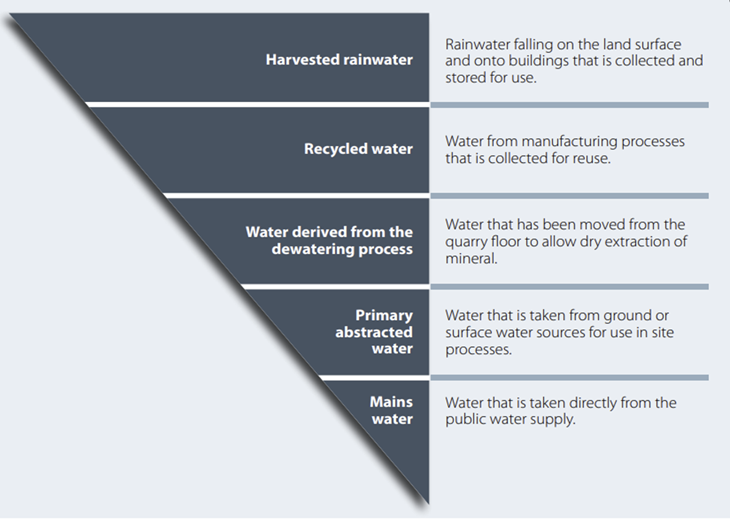
Great strides have already been made to reduce the use of mains water at mineral extraction and production sites, either by making processes more efficient or by harvesting water from alternative sources that are more sustainable. For examples of interventions by members to reduce water use refer to the publication ’10 years 10 insights’ which reflects on the first 10 years of the UK Concrete Industry Sustainability Strategy.
Responsible Sourcing and Environmental Management certification
Careful management of water is integral to responsible sourcing certification to BES 6001 and ‘Environmental Management Systems (EMS). According to the latest performance report 98.6% of production sites are covered by UKAS EMS and 96% of concrete production is certified to BES6001 Framework Standard for the Responsible Sourcing of Construction Products. These indicators are reported as part of the Natural Environment and Social outcomes commitments respectively.
Water in concrete manufacture
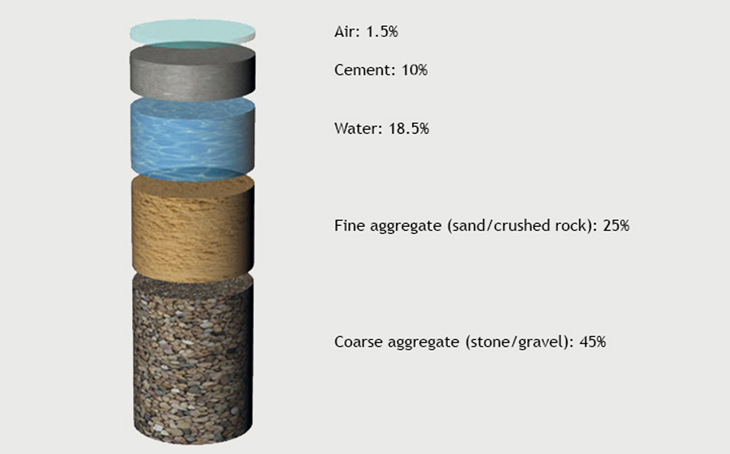
Water is an essential constituent in the manufacture of concrete, along with coarse aggregate, fine aggregates and cement.
Water content plays a part in determining the fresh and hardened properties of concrete including the hydration of the cement, and for the consistence of the fresh concrete. Water is typically added at the batching plant and makes up 18.5% of concrete by volume at point of placing. Some of this water is lost either by evaporation or leaching during the curing process.
For making concrete, the suitability of water for making concrete is established by conforming to BS EN 1008: 2002. This standard gives guidance on mixing water for concrete and the use of water recovered from processes in the concrete industry.
Water content at a specified consistence depends on:
- aggregate size, shape, particle size distribution, moisture content, and absorption.
- cement content and combination type.
- the end use of the concrete and placement method.
- admixture type
New guidance for the sustainable specification of concrete with regards to water use is currently in development by The Concrete Centre.
In addition to the water directly incorporated into the concrete, water is also used elsewhere as part of the manufacturing process, such as cleaning concrete trucks, and for dust suppression.
Measuring water in concrete products
Water use associated with the production of concrete products is reported in EN 15804-compliant EPDs under the indicator use of net freshwater resources, covering modules A1–A3.
More information on EPDs and links to the MPA industry average EPDs for a range of concrete products can be found here.
Using concrete to manage water in the built environment
The versatility, durability, strength, cost effectiveness and water-resistant properties of concrete means that it is widely used to manage water within built environment. It can withstand immense pressure from water flow, resists corrosion, and can last for decades with minimal maintenance. Concrete does not leach toxins into water, making it safe for potable water supply systems.
The long list of uses utilising these performance benefits includes dams, reservoirs, storage tanks, below ground drainage and processing, fresh water supply, culverts, sea walls, bridges and aqueducts, sewage plants, property level floods resilience, permeable paving solutions and other products for SuDs.
Flooding and storm water
Concrete is essential for the provision of a safe water supply but also to help manage the combined climate change hazards of drought, flood and storms. More guidance is available through The Concrete Centre’s Climate change resilience compass.
Sustainable Drainage systems (SuDs)
Sustainable drainage systems are designed to manage surface water runoff and are fundamental to reducing the risk of surface water flooding. Many incorporate nature-based solutions, to reduce the number of impermeable surfaces in a development.
There are also many concrete products designed to be used with SuDs, providing essential hard standing and thoroughfares as well as effective rainwater management. These include a variety of types of precast block paving, pervious concrete cast in situ and hollow concrete kerbs.
These concrete SuDS together with concrete culverts and buried concrete pipes and storm water tanks perform an essential role in flood risk management.
The article, Magic Sponges, in Concrete Futures 2025, addresses common misconceptions about SuDS, and explains why permeable urban landscapes are more important than ever.
A comprehensive review of all aspects of concrete block permeable paving can be found in Edition 7 of ‘Understanding permeable paving’ published by Interpave, MPA Precast.
The Interpave website also includes a collection of exemplar case studies and other useful guidance related to block paving.
Below ground drainage
This short video outlines some of the many precast concrete below ground drainage products available to implement SuDS and how standards and practices are evolving.
The MPA Precast website provides links to technical guidance, case studies and product suppliers for precast concrete drainage and SuDs products. (insert link)
This publication reports on a recent round table that brought together industry experts to discuss Revitalising the UK's Drainage Infrastructure.
Other useful resources include
Wetland habitat creation by UK Quarrying
The UK quarry industry has a long track record of delivering biodiversity net gain and substantial areas of wetland habitat via the regulated processes of quarrying and restoration. MPA members work closely with bodies including Natural England, the Wildlife Trusts and the RSPB and to date have delivered over 1900 hectares of wetland habitat across the UK, with a further 3000 hectares in the pipeline, delivering multiple natural capital and ecosystem benefits including water storage and flood management. A video outlining some completed and in progress examples of successful quarry restoration and wetland habitat creation can be viewed here MPA Quarries & Nature 2021 … A 50 year success story - Complete Show.
 Back to Concrete Compass main page