Sustainability Series
Week 2: Design and specification interventions to reduce carbon using concrete
There are many opportunities to reduce carbon through the design and specification of a concrete frame. This week will offer practical guidance on specifying concrete and its constituents and introduce tools that help with the comparison of embodied carbon, cost and construction time across various frame options. We also share the latest advice on achieving lower-carbon solutions in current concrete projects.
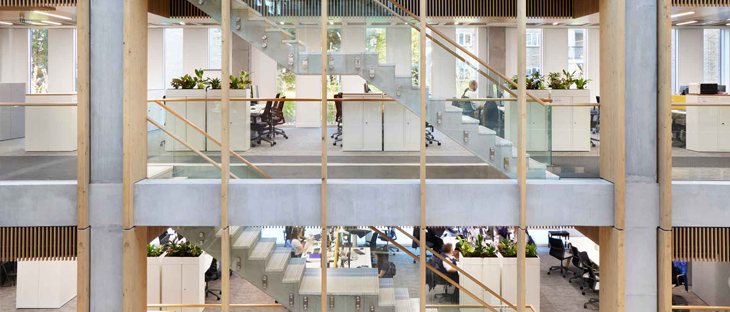
High levels of GGBS and a lean ribbed-slab structure have helped to reduced embodied carbon by 30% at Tatehindle’s admirably restrained HQ for the Salvation Army. Image: Jack Hobhouse.
Webinar: Design and specification interventions to reduce carbon
This webinar highlights key interventions to reduce the embodied carbon of concrete structural frame. Speakers share their experiences of working with project teams and clients to achieve carbon reductions through specification and design interventions on a wide range of schemes.
This webinar was delivered live on 2 October. A recording of the session is available here.
________________________________________________________________________________________
Sustainability Series FOCUS events
Sustainability Series FOCUS: Specifying concrete using the TCC-BS 8500 tool
The TCC-BS 8500 Tool simplifies the process of specifying concrete to BS 8500:2023, helping designers make informed, compliant and sustainable choices. By entering parameters such as exposure classes, design strength and cover, the tool identifies the limiting values needed to meet durability requirements across all exposure classes, including carbonation, chlorides, sulfates and freeze-thaw attack. This session will walk through the tool sheet-by-sheet, providing practical guidance on how to use it effectively.
A beta version of TCC-BS 8500 is available to download free .
________________________________________________________________________________________
Spotlight on: Specifying Sustainable Concrete - New guidance
Specifying Sustainable Concrete is now published as a suite of documents which give guidance on the constituent parts of concrete and key considerations for achieving sustainable specifications. The documents are intended to be complementary to each other and should be read in consultation with other documents in the series.
- Specifying Sustainable Concrete: Cements is the latest addition to the suite of documents, giving guidance on this key component of concrete – the guide can be accessed here.
- Specifying Sustainable Concrete: Using 56 day concrete strengths has recently been updated to reflect the latest guidance in BS 8500:2023 and the second generation of Eurocode 2. The revision is available here.
- The full suite of Specifying Sustainable Concrete titles is available here.
________________________________________________________________________________________
Spotlight on: Concept - New update to Version 5.2
Concept is a free conceptual design tool which enables designers to quickly compare embodied carbon, cost and construction time for a wide range of concrete frame options. It is intended to be used for selecting the most appropriate scheme for a concrete frame building, and to give initial member sizes. Concept version 5.2, released in September 2025, is the latest version of the tool. This revision incorporates updated Market Benchmark carbon data. This is an update to version 5 of Concept, which incorporates waffle slabs and opportunities for designers to alter beam widths.
- Concept can be downloaded free from The Concrete Centre website and there are a range of resources available to help users get started on the Concept webpage.
- ‘Cutting carbon with Concept’ (CQ Issue 289 Winter/Spring 2025) shows, through worked examples, the carbon savings that can be achieved through selecting more material-efficient options and how Concept can be used to quantify these savings.
________________________________________________________________________________________
Spotlight on: NSCS
The National Structural Concrete Specification (NSCS) fifth edition has recently been published. The revision includes additional sections on specifying sustainable concrete, to help facilitate the uptake of lower carbon cements and concretes and enable more sustainable concrete structures.
- The NSCS is now available to access online to allow for more collaborative working. The NSCS can be accessed for free via the CONSTRUCT website here.
- The Concrete Centre hosted a webinar with the NSCS project team in September 2025 to introduce the new resource and demonstrate how it can enable sustainable concrete products. A recording of the webinar is available to watch on-demand here.
- Concrete Quarterly Autumn 2025 features a technical article on the recent update to the NSCS and can be accessed here.
________________________________________________________________________________________
Spotlight on: Carbon data for project LCA
Increasingly, embodied carbon assessments are required as part of the procurement and design process, whether for early-stage design, the technical design and construction stage, or post completion of the building. Standards and guidance, such as EN 15941, RICS Whole Life Carbon Assessment (WLCA) standard and IStructE's How to Calculate Embodied Carbon, address the choice of construction product data for building level carbon assessments. The first-line choice of carbon data will depend upon the design stage at which the embodied carbon calculation is being carried out. At the early design stage, ideally UK-specific sector EPDs should be used.
- The Concrete Centre's compass webpages provide signposts to relevant resources and guidance on key topics. The newly-created carbon data compass aims to help navigate to resources to select the most appropriate and highest quality carbon data for concrete at different stages in the design process. The compass page can be viewed here.
________________________________________________________________________________________
Spotlight on: Precast guidance
Precast concrete offers a range of benefits for designers looking for a sustainable and material efficient option for their building or structure. To maximise the benefits it is essential that the manufacturing and installation process is understood by the design team and that early collaboration enables the most efficient use of offsite manufacturing techniques.
- HMP Millsike showcases a platform approach to concrete MMC: UK Concrete has highlighted this excellent case study of a precast concrete project which achieved carbon savings through evolution of its platform-based design. Further learnings from the project will be released in new guidance from MPA Precast and The Concrete Centre, to be available in the coming weeks.
- Download MPA Precast's Case Study Compendiums which feature a selection of projects from across the precast concrete product range and showcase the flexibility and innovation of the sector.
- To hear more about precast concrete’s role in reducing embodied carbon, view the webinar Design and specification interventions to save carbon using concrete, click here.