Three Chamberlain Square is Birmingham’s first BREEAM Outstanding office. Nick Jones learns how FCB Studios and Cundall challenged conventional wisdom about the workplace to deliver its superefficient structure
Even as it was rising from the ground, Three Chamberlain Square was turning heads. This wasn’t just because of its plum location, next to the grade I-listed Birmingham Town Hall. “As the building was going up,” recalls Tim Stidwill, partner at structural and services engineer Cundall, “people were looking at the slabs and saying, how is that possible? How are you making them so thin?”
Designed by Feilden Clegg Bradley Studios, Three Chamberlain Square is a blast of colour amid the Victorian gothic and 1960s brutalism of central Birmingham. The ten-storey office block, the fourth commercial building in MEPC’s Paradise devlopment, is framed by orange terracotta fins and deep-red aluminium spandrel panels. Ornate ogee arches wrap around the double-height ground level and the top two storeys, which slant inwards like a mansard roof. “You find these forms and motifs all around Birmingham and it’s been fun to reinterpret them,” says Alina White, partner at FCBS. “It was important to be different because this is a new kind of building for Birmingham.”
Three Chamberlain Square is the first to earn BREEAM Outstanding and the first NABERS 5-star base building in the West Midlands, hosting 17,500m2 of all-electric, grade A office space, equipped to be net-zero carbon in operation. The structure’s upfront embodied carbon represents a 100% improvement on the UK Net Zero Carbon Buildings Standard target for 2030, and achieved a B rating under the SCORS scheme, which focuses on the carbon footprint of the primary structure for lifecycle stages A1-A5 (cradle to completion).
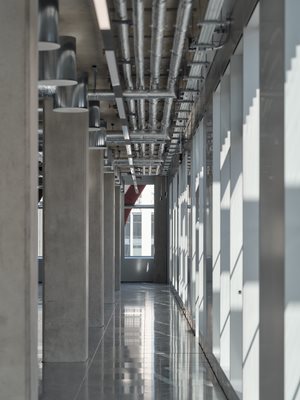
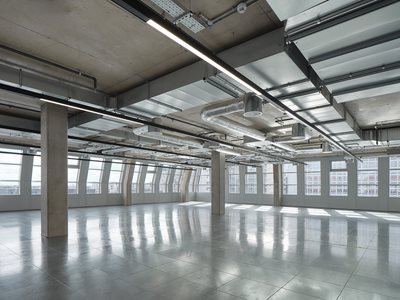
This is where the slabs come in. The frame is an extremely lean assembly of in-situ reinforced concrete, comprising post-tensioned (PT) slabs, just 215mm thick, on a tight 7.5m structural grid, the whole assembly borne on a raft foundation without piles. The PT slabs are visible as exposed flat soffits and there are as many as 22 exposed concrete columns on a typical 2,100m2 floorplate, with a line of six separating the 16m-deep zone between the lift lobby and the front of the building.
This runs counter to commercial development lore, in which open, column-free floorplates have almost become a defining characteristic of grade A space. The rationale is that this offers tenants a blank canvas to divide up and fit out however they wish, as well as longer-term flexibility to accommodate more radical change. When the design process for Three Chamberlain Square began, guidance from the British Council of Offices advised that columns should be no closer than 9m apart.
However, the early stages of the project also coincided with Covid, which suddenly called into question all aspects of workplace design. Cundall took the opportunity to talk to property agents, who agreed that more columns would have little impact on commercial viability. They do, on the other hand, have a significant impact on carbon. Longer spans typically need deeper slabs: a conventionally reinforced concrete flat slab with columns 9m apart tends to be 300mm. By reducing the grid to 7.5m, Cundall’s analysis suggested that this could be slimmed to 225mm, a 25% reduction in material. Post-tensioning would cut the steel content in the slabs by 45-50%.
“You could easily have made this structure completely column-free from the core to the perimeter,” says Stidwill. “But having the extra columns allows everything to be kept as light and thin as possible. You’re using less material, you’re putting less weight into the building, so the columns don’t need to be so big, and the foundations don’t need to be so big either. These benefits go all the way down through the building.”
Cundall initially assessed six frame options, using its in-house embodied carbon measurement tool, which follows the RICS and IStructE methodology. Two bays of the structure were analysed over the full height of the building, with options including cross-laminated timber and CLT-steel hybrids. The best-performing solution, however, was a concrete frame based on 225mm-deep PT slabs, with a 50% GGBS mix used throughout. This came out with an A1-A5 embodied carbon value of 131kgCO /m2, equivalent to a SCORS A rating.
In the event, the contractor was concerned that the slow early strength gain of a GGBS mix would delay the stressing of the tendons in the PT slab, particularly in colder weather. It therefore opted for a CEM I mix, partially compensating for the additional carbon by reducing the slab thickness by a further 10mm. This resulted in an embodied carbon value of 175kgCO /m2 for the completed frame.
Giving the contractor this flexibility was an important part of the sustainability strategy, designed to avoid unintended consequences. The client chose not to impose specific carbon limits for different building elements. Instead, it wrote a strict limit into the design-and-build contract of 600kgCO /m2 for the whole building, as well as setting a stretch target of 475kgCO /m2.
“Sometimes, if you set a limit, it restricts how the contractor can do the work,” says Stidwill. “This way, there was really good collaboration between the client, consultants and contractor on monitoring carbon performance throughout the project. There could be flexibility on some elements, but everyone knew that lower carbon solutions would be needed somewhere else to meet the project requirements.”
A key move was to specify double rather than triple glazing, because the combined upfront and whole-building operational carbon emissions were lower for double glazing. Expendable finishes are also kept to a minimum, with exposed soffits and columns in the offices, as well as low embodied carbon raised floors. The public-facing areas have a warmer, richer palette, made almost entirely from low-carbon, natural materials. These include mycelium wall panels, grown in moulds to the specified shape, and wood-fibre acoustic baffles, which add texture to the smooth, exposed concrete frame.
The flexible, holistic approach to embodied carbon meant that, even without GGBS in the slabs, the whole-building value came to 449kgCO /m2. For Stidwill, the use of CEM I suggests that further savings should be easily attainable on future projects. “There’s definitely scope for having a range of mixes at different times of year. If even a quarter of those slabs were 50% GGBS, it would bring the structure closer to SCORS A. While we need to keep some flexibility in the contract, as consultants we can definitely push a bit harder.”
The services design takes a similarly lean approach. “From the outset, the fundamental strategy was to achieve realistic and reasonable operating loads for the average occupier, rather than designing for peak loads that might only apply for one or two days of the year,” says Mike Gosling, partner at Cundall, which also oversaw the services design. “Generally, flexibility can add quite a lot of carbon, as you end up oversizing systems. We went down more of an adaptability route, with roof space for an additional air source heat pump if needed, and capacity for tenants to move their electrical load between different floors.”
It is often argued that a “loose fit” helps buildings to evolve to changing needs, reducing the risk of demolition and redevelopment. At Three Chamberlain Square, FCBS and Cundall have taken a slightly different approach. The building’s future is instead tied more to the strength of its identity, particularly those brilliant red ogee arches that rise above the Town Hall on the Birmingham skyline. It already feels like an indelible part of the city, says FCBS’s White. “When the sun shines through the rooftop arches, and they cast their shadow on the Town Hall, that’s a special moment.”
THE RETURN OF THE COLUMN
Is this the workplace of the future?
Embracing the column has brought down Three Chamberlain Square’s embodied carbon. The big question is whether it can create spaces where people actually want to work. The initial evidence suggests it does, with the building already fully let to blue-chip companies Ernst & Young, Eversheds Sutherland, CBRE and Forvis Mazars.
FCBS has made most of the building’s location to give the offices a definite wow factor. Despite a strict glazing
ratio of 40% to control solar gain, windows stretch between desk and ceiling height, framing views of the Town Hall, and drawing daylight through to the lift core on all sides.
The upper floors follow the pitch of the mansard-style roof to create more intimate loft-like spaces behind slanted perimeter columns. The top floor opens out onto a terrace framed by a terracotta and aluminium pergola, which looks down on the square and beyond to central Birmingham.
The additional columns don’t really inhibit flexibility, says Alina White, partner at FCBS. “It’s become accepted wisdom that if you want a flexible space you need 15m, but you don’t.” The 7.5m grid offers space for banks of eight desks, as well as the option to partition off individual offices or larger conference rooms.
Nothing feels restrictive: the thinness of the PT slabs helps to maximise floor-to-ceiling heights, as do the exposed services, suspended below the soffits in a rationalised, uncluttered layout. Some of the windows are openable, allowing tenants to let in fresh air and connect to the street life below. And if future tenants need to expand, soft spots have been included in the slabs, so that stairs can be added between floors.
CITY OF ROCK
Why Birmingham is built for raft foundations
Another advantage of a smaller grid is that it spreads loads more evenly across the building footprint. This made it possible to found the structure on a raft rather than deep bored piles, saving huge amounts of material and time.
“If we’d had a longer span, I don’t think the raft foundation would have worked,” says Cundall’s Tim Stidwill. “It would have placed too much stress on the ground.” The site also had the geological advantage of a stable bedrock, little more than a metre below the city.
“There’s a sandstone ridge that runs through the centre of Birmingham, which you can read in the historic cityscape. It’s a really good material to build onto and it’s also an aquifer, so it attracted a lot of industry.”
The west side of Chamberlain Square is raised a little higher, above a disused pedestrian tunnel from the 1960s ring road development. This was removed and the whole footprint excavated to the sandstone bedrock, a depth of 4m. The raft was then cast in-situ to depths of between 300mm and 1m. “A pure raft would have a constant depth but we have made it work more efficiently with localised thickenings under the columns,” says Stidwill.
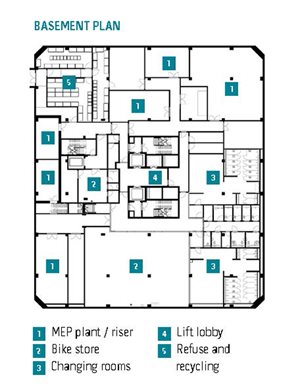
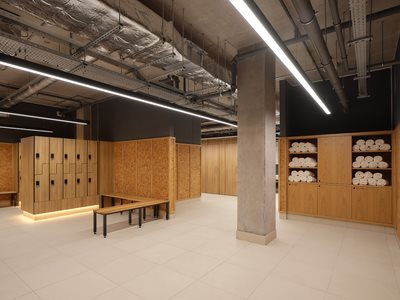
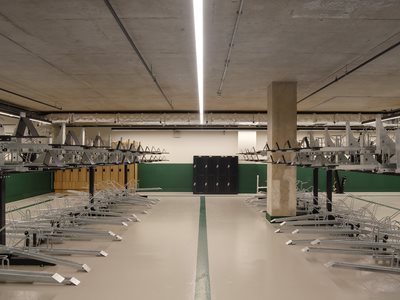
The raft solution also left space for a basement that covers the whole footprint – the original design had tried to minimise excavation with a far smaller underground level. This cavernous space has become an impressively provisioned facility for the building’s cyclists, with 220 bike racks, 27 showers and generous cork-lined changing rooms.