The Stephen Schwarzman Centre for the Humanities is Oxford’s largest ever construction project and the world’s first Passivhaus concert hall. Tony Whitehead finds out how it was designed and assembled from 3,000 precast parts.
The residents of central Oxford had become accustomed to the large building site next to the famous Radcliffe Observatory – supposedly a new facility for the university. For months, not much seemed to be happening. Then suddenly….
“A friend of mine lives nearby,” says Andy Barnett, principal with Hopkins Architects. “She couldn’t believe the speed it came out of the ground. It’s a four-storey, 23,000m2 building, but the whole envelope went up and was weatherproof in just ten weeks. That’s faster than the average kitchen extension.”
This time-frame is all the more remarkable when you consider that the Stephen Schwarzman Centre for the Humanities is the university’s largest ever building project, and a complex, high-specification building. As well as extensive study areas, seven libraries, tutors’ offices, an exhibition gallery, two cafes and a bar, it contains four impressive performance spaces including a 500-seat concert hall, a 250-seat theatre, a 100-seat cinema, and a smaller sound-lab or practice space. The concert hall is designed to provide world-class acoustics, and all four performance spaces have sophisticated “box-in-box” acoustic separation built into the structure.
If that were not enough, it is also the largest building of its type in the UK to achieve Passivhaus certification – one of the most demanding environmental standards in existence, requiring unusually high levels of airtightness and exceptional efficiency in both embodied and operational carbon. All in all, it is the kind of project that could easily have taken three or four years to construct, yet the total build time was just 30 months. Barnett says that the speed of delivery was almost entirely attributable to the approach taken by the contractor, Laing O’Rourke, and its use of modern methods of construction.
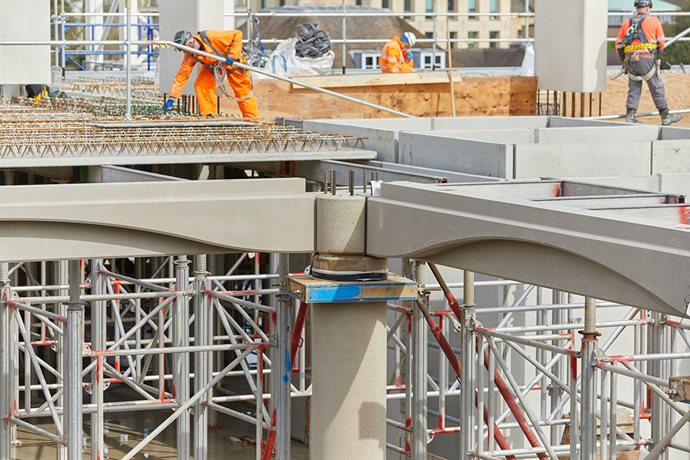
The structure and facades are made from 3,000 prefabricated concrete elements, which were manufactured offsite while the foundations and basement levels were being constructed. “The university wanted quick construction and a totally reliable completion date,” explains Barnett. “That was one of the main reasons we went for predominantly precast concrete – offsite manufacture gives you that control, partly because you are less affected by the weather.”
It also marries well with the technical demands of Passivhaus, he adds. “Offsite prefabrication enables elements to be constructed to tight tolerances, and that really helps when you are aiming for a very airtight building.” Acoustic separation was another early consideration: “Academic teaching can’t be disrupted by sounds from a concert, so the solidity and sound-containing qualities of concrete made it a likely frame material from the start.”
This early hunch was proved correct when structural engineer AKT II modelled the frame in steel, concrete, cross-laminated timber and various hybrids. Assessed against a number of metrics including cost, floor-to-ceiling heights and carbon efficiency, concrete was the clear winner. But the building was originally conceived with an in-situ frame, and only became precast at stage four, when Laing O’Rourke came on board.
“The completion date was very important to the client,” says Valentina Galmozzi, AKT II’s design director. “It had to be August 2025. With so many different departments moving from 26 locations to the new building, you can imagine the problems if it was incomplete at the start of the academic year. Changing from in-situ to precast was quite straightforward though. We didn’t really have to change any of the thicknesses of the columns or slabs, it was all in the detailing of how the elements went together.”
Much of the building is arranged on a 6m x 6m grid, with some much larger spans for specialist areas such as the concert hall. “The grid size stems from the dimensions of the tutors’ offices, the smallest of which are 3m x 3m,” says Galmozzi. “These take up much of the space in the upper floors of the building. We didn’t mind having the relatively large number of columns this grid involves as they are naturally hidden in the office walls. The small spans allow slimmer slabs, which saves material and carbon.”
CAST IN STONE
A timeless Oxford facade – made in Worksop
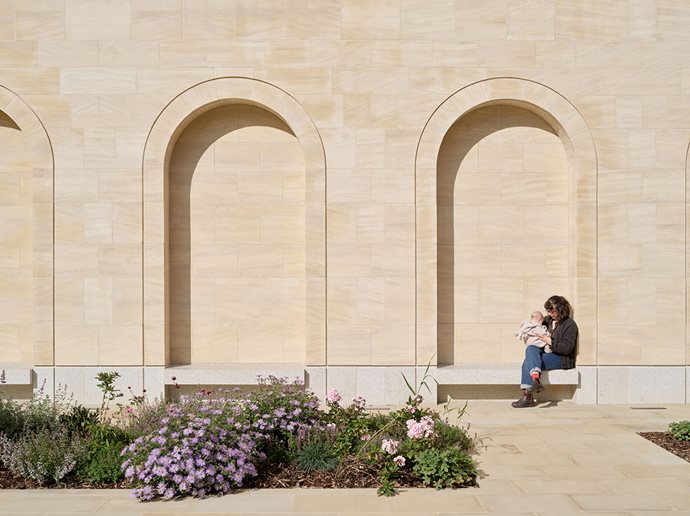
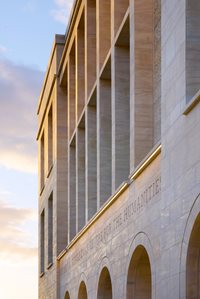
Clad in local Clipsham stone and handmade brick, it is obvious from first glance that the Stephen Schwarzman Centre for the Humanities is a very high-specification building. It has a timeless look, very much in keeping with its illustrious neighbours: the similarly stone-faced Radcliffe Observatory and the Oxford University Press.
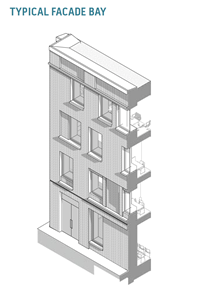
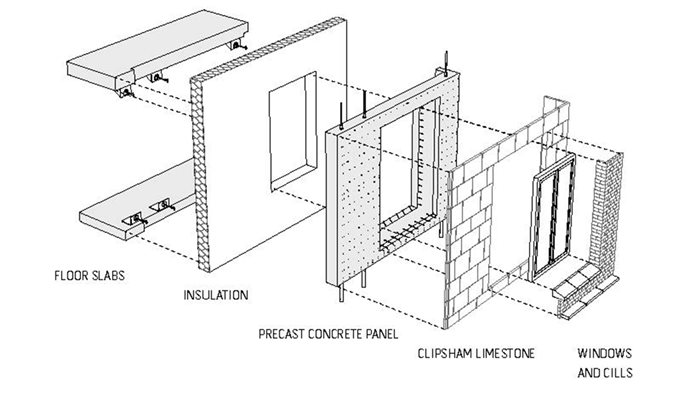
Though they look as if they were laid by hand on site, the facades were constructed offsite, from 326 concrete-backed prefabricated panels. Like the columns and slabs of the structure, these panels were made in steel moulds.
 “Unlike timber moulds, these can be reused almost indefinitely, avoiding timber waste,” says Alex O’Gorman, senior project manager at contractor Laing O’Rourke. “In addition, the moulds were adjustable, so the size of the units could be altered without the need for new ones.”
The majority of the facade panels comprised a slim reinforced concrete back of 100mm, faced with 50mm of stone or brickwork. “In total, there were 18,500 pieces of stone and 160,000 bricks, but none of these materials had to travel far,” he says.
 “The stone is from Rutland, the brick from York and the cement from Ketton – all within 100 miles of our fabrication facility in Worksop.” The panels of the upper floors were typically 3.3m x 6.7m, arranged in landscape orientation, and 3.5m x 5.4m for ground-floor panels in portrait orientation. Weight varied from 8 to 12 tonnes, with the heaviest unit 13.4 tonnes. “Panels with windows were delivered with the glazing already fitted,” says O’Gorman. “In factory-controlled conditions, we can prefabricate to the very close tolerances required for Passivhaus airtightness.
They also fitted together, via vertical and horizontal connections, with hardly any gaps at all, helping to achieve the architect’s vision of a monolithic facade that looked hand-built, rather than made up of sections.” The panels were self-supporting – forming a stacked rather than a hung facade. “Being just tied back to the frame helps with cold bridging, and taking the weight off the frame enabled it to be slimmer and lighter, saving material and further lowering embodied carbon.”
The majority of the frame is constructed using rectangular precast columns and precast twin-wall elements, the latter comprising outer and inner slim reinforced concrete panels connected by a steel lattice, into which ready-mixed concrete is poured. Their use enabled the construction of continuous, solid walls while still benefiting from rapid assembly of relatively lightweight panels.
A similarly hybrid precast/in-situ approach was used for the majority of the floors, which were constructed from lattice slabs, many of them 6m x 3m to fit the grid. “These were 75mm-thick slabs with a lattice of rebar protruding from the upper side,” says Galmozzi. “Once in place the slab is completed by pouring a 225mm layer of concrete on top. Many of them were identical, so there was a lot of repetition and they could be produced very efficiently.” As well as being relatively cheap to produce, lattice slabs are substantially lighter than solid elements, making them easier to transport and crane into place.
They also allowed Laing O’Rourke to increase the use of GGBS cement replacement to lower the project’s embodied carbon. “There were several different mixes of concrete in the building and the percentages of GGBS in each varied, as the contractor wanted to optimise the use in each case,” says Galmozzi. “Because GGBS needs longer curing time, the maximum percentage in the precast element of the lattice slabs was about 30%. Any higher would slow the factory production too much. But for the concrete poured on site, the percentage could be much higher, bringing the overall slab percentage up to about 40%.”
High proportions of GGBS can sometimes slow the programme when used in a standard in-situ frame, she adds, but here the lattice slabs acted as their own formwork. “Below the slabs were a few props, needed only until the poured concrete sets. With no formwork to strike, potential delays due to slow curing largely disappear.” By maximising GGBS throughout, Laing O’Rourke calculated that the embodied carbon of the building had been reduced by 544 tonnes CO2e.
More bespoke structural approaches were required to construct the sophisticated performance spaces, each of which had to be acoustically separated from the main structure. Located in the double-floor basement areas, these have larger spans of 12m,15m and 18m. “For these, we used steel beams or trusses to support the lattice slabs, and these created the floor above in the normal way,” ” says Galmozzi. “However, each performance area needed a lower ceiling – the top of the interior box – and for these we used hollowcore concrete planks spanning between another separate steel structure.”
The exception was the largest space, the concert hall. This has a stronger traditional ribbed-deck in-situ ceiling, from which a technical platform could be suspended. The floors of these areas were separated from the floor slabs proper by placing a second layer of precast floor slabs on thick rubber acoustic bearings, on top of solid concrete blocks. Inside the main concert hall, the walls are lined with 230 glass-reinforced concrete (GRC) panels and soffits.
The largest of these are 2.5m high and weigh less than 0.5 tonnes. Each GRC wall panel is subtly curved to enhance the reverberation acoustics, and houses a fabric “blind”, which can be variably lowered to adapt them to the requirements of a particular performance. It is a world-class refinement, in a world-class building.
GOLDEN CIRCLES
Designing and manufacturing the columns and beams
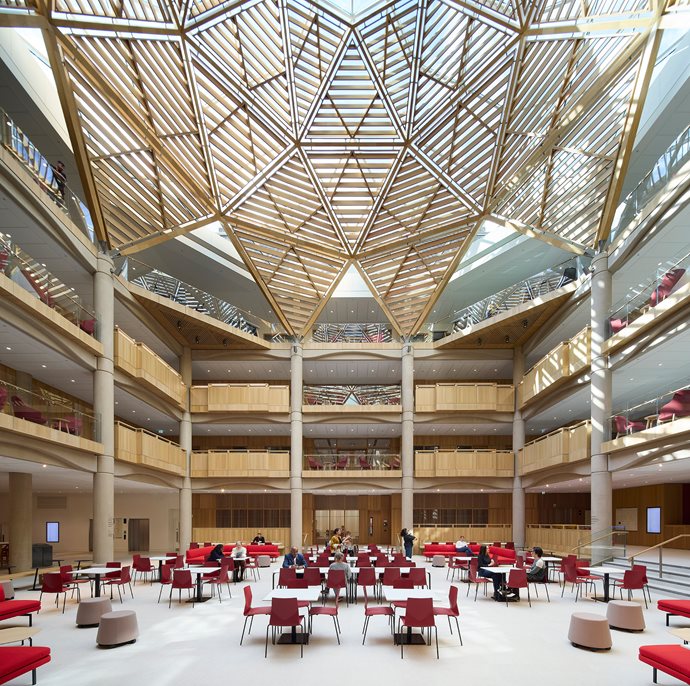
The interior of Oxford University’s new humanities building continues the themes of the exterior, being similarly high-spec with oak panelling and more stonework. But exposed concrete plays more of a starring role, particularly in the Great Hall – a dramatic full-height, multipurpose circulation area, topped by a 60-tonne timber-framed dome.
The dome is supported by 12 circular pillars, 600mm in diameter, rising from the ground floor all the way to roof level. “The concrete has a beautiful, pale, almost golden colouration,” says Hopkins’ Andy Barnett. “It had to be right. The look and feel of the building has a lot to do with the colour palette – so the brick, the stone, the oak and the concrete all speak to one another.”
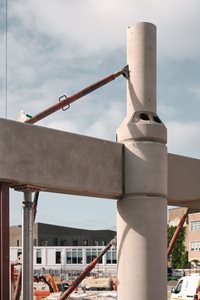 “The colour and texture of the columns was determined by the choice of aggregate, but also by adding pigments,” says senior architect Kitty Byrne. “We started off with dozens of A4-sized samples, then narrowed it down to a few larger ones, and then eventually storey-height mock-ups.”
She explains that the pigments enriched the GGBS concrete in the columns, which tends to produce a paler tone. “We also worked with Laing O’Rourke to develop the steel moulds. We wanted the pillars and beams to de-mould as crisply as possible.”
Spanning between the Great Hall columns is a series of elegantly curved precast beams made from the same pale golden concrete. “We originally designed this arrangement with separate column, node and beam elements,” says Byrne. “But Laing O’Rourke were keen to reduce the number of elements to make the process more efficient. It means you need fewer deliveries, fewer crane lifts and so on.”
Her solution was to integrate the nodes into the columns, leaving a cut-out at the top rear of each column into which beams could be slotted. “We spent a long time detailing the chamfers and joints. When it’s all pointed up, you can’t tell what is a real connection and what’s not – so we got that efficiency without compromising on the appearance. I think it was worth the effort.”
Most visitors would agree. The Great Hall is stunning – an architectural pièce de résistance in which the grand pillars and undulating wave of concrete beams play a key role.