Sustainability Series
Week 3: Climate change resilience and support of nature
Concrete plays an essential role in providing climate resilience of our homes, buildings and infrastructure. It can also be used effectively to support integration and nature into the built environment, to help create spongier cities. This third week of The Concrete Centre’s 2025 Sustainability Series brings together expert speakers, new resources and case studies to demonstrate how.
It will include new guidance based on the latest British Standard guidance for providing property level flood resilience construction (BS 85500), explore sustainable urban drainage solutions using concrete, intensive green roofs and urban tree planting.
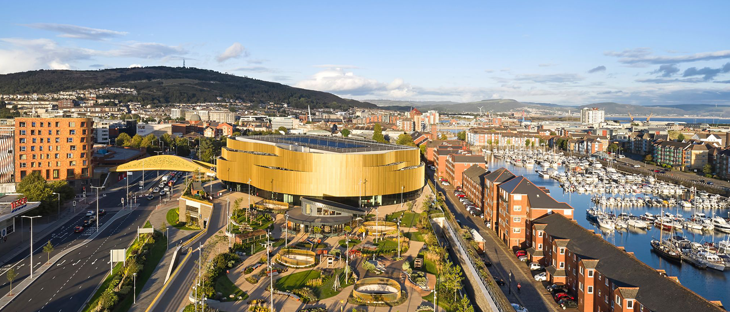
Swansea Arena Green Roof Garden, the largest green roof in Wales. Courtesy of Acme.
Webinar: Resilience and support of nature
Urban trees, green roofs and sustainable urban drainage bring multiple benefits to our built environment. These include support for biodiversity and human wellbeing, mitigating the heat island effect and reduced risk of surface water flooding. This live online event explores some of the ways in which concrete can be used to support their integration, to improve the climate change resilience of our cities.
Catch up on-demand, here.
________________________________________________________________________________________
Spotlight on: Concrete’s role in supporting biodiversity and nature
The principle of embedding nature more effectively into our built environment is one that is rightly receiving a lot of attention and Biodiversity Net Gain became mandatory for development in England from February 2024. The Concrete Centre continues to collect and share best practice and guidance for ways in which concrete can be used to enhance and support nature, both in use and through the process of manufacturing and supply chain.
- Our newly updated Biodiversity Compass helps navigate to a wide range of guidance, case studies and information about industry action on concrete’s role in supporting nature and biodiversity.
________________________________________________________________________________________
Spotlight on: SuDS and below ground drainage
Concrete is essential for the provision of many durable, low maintenance and cost-effective sustainable drainage systems. There are a wide range of products providing essential hard standing and thoroughfares as well as effective rainwater management and integration of nature-based solutions. Below are links to some of the most recent case studies, resources and guidance produced by The Concrete Centre and MPA Precast.
- The article, Magic Sponges, in Concrete Futures 2025, addresses common misconceptions about SuDS, and explains why permeable urban landscapes are more important than ever.
- The technical Application article in Concrete Quarterly, summer 2025, explained how concrete block permeable paving can be used to create durable urban landscapes that support tree growth.
- Case studies of concrete block permeable paving in housing developments: MPA-Precast-Lamb-Drove-Riverside-Court-Case-Study.pdf.aspx
- Revitalising the UK’s Drainage Infrastructure was the topic of a roundtable discussion with input from specialists from academia, policy, engineering and industry. More details, and a report of the discussions can be downloaded here.
________________________________________________________________________________________
Spotlight on: flood defences to support nature
Opening up access to water and the creation of ‘softer’ edges such as beaches, or floodable green spaces is at the core of the nature-based design approaches for the design of coastal and river flood defences. Concrete continues to have an important role to play, providing durable, robust and cost-effective solutions – particularly where there are space constraints. There are also a growing number of projects around the UK that utilise the sculptural potential of concrete to create texture and relief, in order to provide suitable habitat for local fauna and flora.
- Rethinking flood defences is a short webinar exploring some of these innovative projects in development.
- The Concrete Centre’s design competition for UK students of architecture and the built environment has been focusing on providing creative, sustainable designs for projects requiring strategies for flood defences. This year’s brief invites submissions for a museum of mudlarking on the Canvey Island Seafront. To find out more about the competition, which is free to enter and has a prize fund of £3000, refer here.
________________________________________________________________________________________
Spotlight on: Climate Change Resilience
The UK Green Building Council’s recently published Climate Resilience Roadmap has helped to raise awareness of the urgency and importance of addressing and preparing for the impacts of climate change. At the launch event it was noted that buildings are our first line of defence.
Key hazards identified include floods, heat waves and wildfires. The inherent performance characteristics of concrete and masonry structures can be used to embed effective and passive resilience within our built environment to all three.
- The Concrete Centre’s climate change resilience compass has been recently updated to help navigate to new and evolving resources and design guidance to help designers and other construction professionals make informed decisions for climate-ready development.
- It includes this online CPD presentation providing design guidance for embedding climate change resilience using masonry construction: Embedding climate change resilience using masonry.
________________________________________________________________________________________
Spotlight on: Property level flood resilience (PLFR)
The guidance for improving the flood resilience of properties has taken a significant step forward this year with the publication of the revised BS 85500 - Flood resilient construction – Improving the flood performance of buildings. The guide includes an extensive list of the impacts of flood water on material and building elements, including MMC, and provides detailed guidance for new and retrofit development using detailed, co-ordinated drawings. Importantly it also includes guidance on how to improve resilience against the impacts of surface water flooding, a hazard applicable to many buildings, as not restricted to those in an identified flood zone. All of the new recommended solutions illustrated utilise a concrete or masonry structure.
- Further guidance on how to reduce the impacts of water in new construction, following guidance provided in the new BS 85500, is provided in a short webinar.